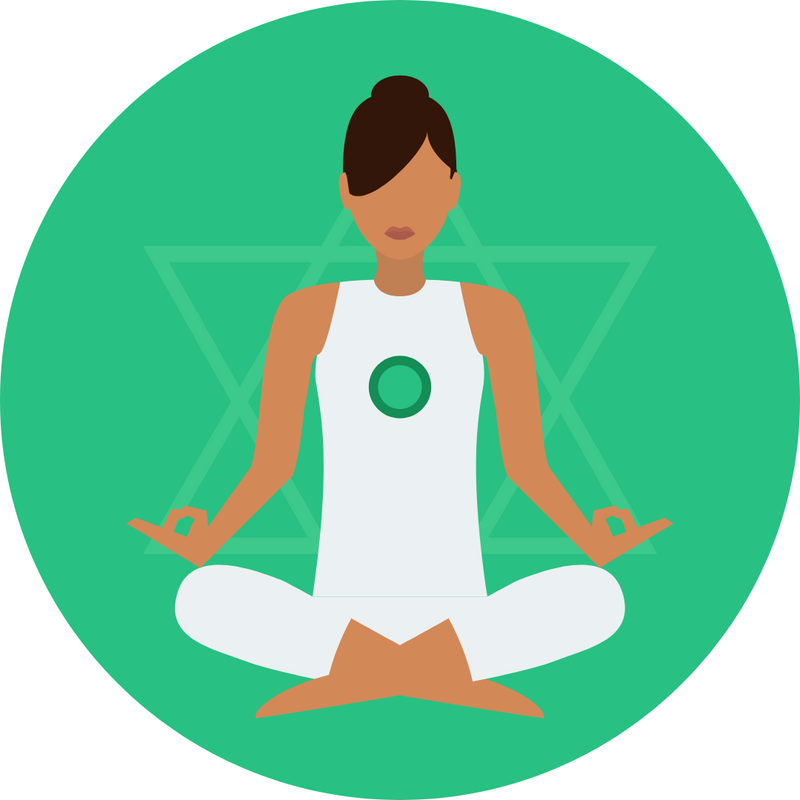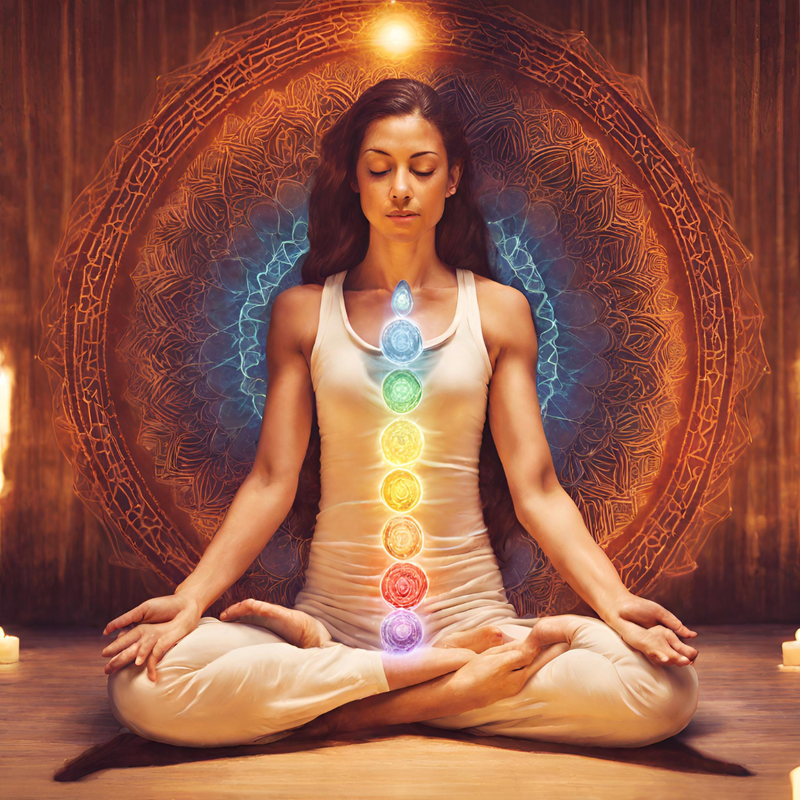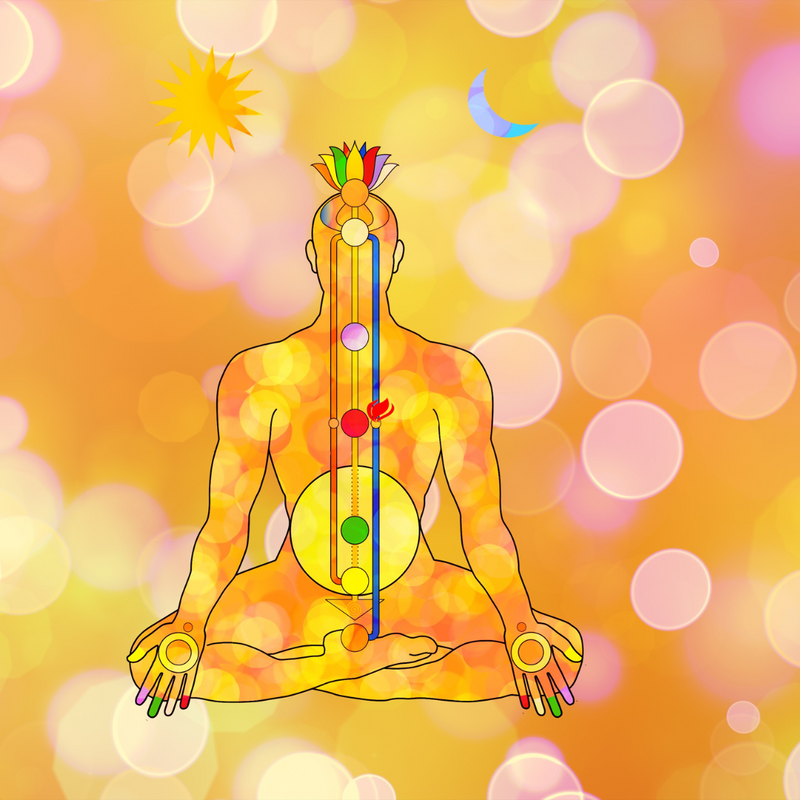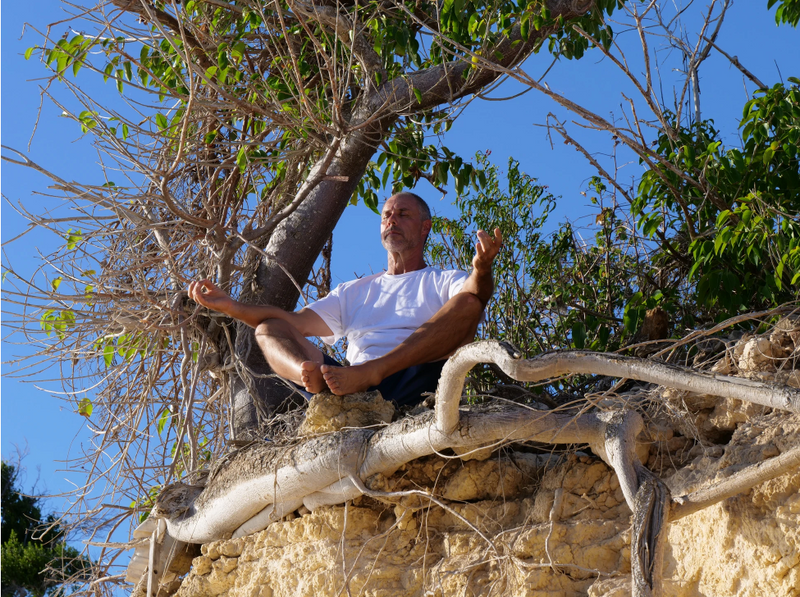

When we talk about chakras, most of us immediately visualize a figure in meditation, crossed by an axis of light punctuated by seven colored spheres: red, orange, yellow, green, blue, indigo and violet.
This image, which has become universal, seems to come straight from an ancient Indian wisdom… and yet, it is much more recent than we think.
In self-help books, on yoga mats, and on social media, the “seven rainbow chakras system” has become widely accepted.
- Red for safety,
- orange for creativity
- Yellow for confidence.
- green for love,
- blue for communication,
- Indigo for intuition,
- Violet for spirituality.
This model is so familiar that it seems immutable, almost scientific. It has given the chakras an aesthetic dimension, simple to remember and reassuring: each color corresponds to an emotion, an energy, a part of the body, glands, etc.
But behind this visual harmony lies a much more complex… and far more fascinating truth.
# How this vision became established in modern wellness culture
The association between chakras and the light spectrum did not originate in ancient Sanskrit treatises. It emerged gradually in the 20th century, as Eastern thought spread to the West.
The first references to the chakra system were translated at the beginning of the last century by researchers, mystics and theosophists fascinated by India. Among them, CW Leadbeater , a British clairvoyant, published The Chakras in 1927: a seminal work in which he describes, according to his subtle perceptions, luminous energy centers, each endowed with a color and a vibration.
But at that time, the hues he attributed did not yet correspond to the rainbow as we know it today. It was only at the end of the 1970s that a new link was forged: Christopher Hills , author and spiritual physicist, proposed a direct correspondence between the seven chakras and the seven colors of the visible light spectrum .
His book, Nuclear Evolution: The Rainbow Body , became a reference for an entire generation. From then on, the imagery of the “rainbow body” became prevalent in yoga schools, energy training programs, and New Age literature.
In just a few years, this codified version has become deeply ingrained in the collective imagination. The color code has become a universal language of modern well-being : an accessible, aesthetic, and intuitive emotional map.
# Why we think red always corresponds to the root chakra
Of all the associations, that of red and the root chakra (Muladhara) is the most deeply rooted.
And that makes sense: red evokes the earth, energy, heat, survival. It instinctively activates the base of the body, the legs, the blood, the life force.
But in ancient tantric texts, Muladhara is not specifically described as red.
It speaks of a four-petaled lotus , a bīja mantra “LAM” , of earth as an element , and of a yellow square representing stability, not a scarlet halo.
This link between “red = root chakra” is therefore a modern symbolic construct , based on the parallel between the vibration of red (low wavelengths) and the energy density of the first center.
In other words, the association is based on a vibrational and pedagogical analogy , not on an ancient tradition.
This correspondence works wonderfully for teaching, visualizing and feeling… but it does not necessarily reflect the original truth of tantric practices.
This is where the revelation begins: the chakras, in their original essence, have never been fixed in a color code.
They were and still are living gateways of consciousness , spaces of experience, vibratory fields in perpetual motion.
The authentic origin of the chakras in ancient teachings
# Tantric and yogic texts at the origin of the energy system
To understand the true nature of the chakras, one must leave the language of colors and return to that of sacred texts .
The first structured descriptions of the chakras did not come from modern postural yoga, but from the tantras , those esoteric teachings of medieval India, written between the 8th and 16th centuries.
The best-known of these, the Śat-cakra-nirūpaṇa (16th century), describes six main centers (and sometimes a seventh, the Sahasrara, at the top). This treatise, associated with the kundalini tradition, details the chakras not as “colored wheels,” but as vibrant lotuses bearing sounds, symbols, and deities.
These texts were intended for initiates , accomplished yogis who worked on mastering breath (prāṇa), concentration (dharana = concentration on a single point) and the ascent of spiritual energy through the subtle spine, called sushumnā nāḍī .
Their purpose was neither decorative nor educational: it was a path of awakening , an inner mapping leading to the liberation of consciousness.
Thus, in the tantric tradition, chakras represent vibrational states of being , gateways between the body and consciousness, much more than a simple series of “energy wheels”.
# What the tantras actually describe: lotus, mantras, and breaths
Tantras describe each chakra as a lotus with multiple petals.
Each petal bears a Sanskrit letter, a bīja (its root) , an elemental symbol, and a guardian deity .
The whole forms a living geometry: an inner mandala.
For example :
- The root chakra (Muladhara) is a four-petaled lotus, associated with the earth element, the mantra LAM , and stability.
- The heart chakra (Anahata) is a twelve-petaled lotus, linked to air , the sound YAM , and the subtle vibration of universal love.
- The throat chakra (Vishuddha) has sixteen petals , is associated with ether , the HAM mantra, and the vibrational purification of the word.
Yogis used these correspondences to activate subtle consciousness : they recited mantras, visualized the shape of the lotus, and directed the breath into the energy channels (nāḍī).
This process was called kundalinī sādhanā , the practice of “awakening the serpentine energy”.
In other words, the language of the chakras was primarily auditory, symbolic and vibrational , and not visual.
The energy was not seen, it was felt : in the breath, in the warmth of the body, in the vibration of the mantra.
The Tantras taught that color was only a secondary manifestation of vibration, a form that the mind could perceive after awakening consciousness from the center.
# The absence of a fixed color code in Sanskrit sources
Contrary to the modern image of the “rainbow body”, Sanskrit texts do not give a fixed correspondence between each chakra and a color .
Some mention nuances, but these vary from text to text: a chakra can be described as “bright as the moon”, “bright red as fire”, or even “golden as the sun”, depending on the symbolic context and the deity invoked.
These colours were metaphorical , intended to evoke states of consciousness or inner lights perceived during meditation, not to form a uniform graphic system.
No ancient text describes the chakras as the seven bands of a continuous light spectrum.
That is why, when we speak today of a “green” or “blue” chakra, we are actually using modern language , a poetic synthesis resulting from an encounter between Western science, psychology and Eastern mysticism .
But this lack of codification does not detract from the depth of the concept.
On the contrary: she reminds us that working on the chakras is a personal and living experience , not a fixed pattern.
Each chakra is an inner world , a unique space for exploration whose light changes according to the vibration of the one who contemplates it.
And it is in this fluidity, in this mystery, that the true richness of the tantric tradition resides.
The true story of the chakra rainbow
# The influence of Theosophy and CW Leadbeater at the beginning of the 20th century
To understand how the chakras acquired the colors we know today, we must go back to a fascinating esoteric movement that emerged at the end of the 19th century: Theosophy .
Founded by Helena Blavatsky , the Theosophical Society sought to unify the great wisdom traditions of the world, Eastern, Western and mystical, under a single universal spiritual perspective.
It is in this context that Charles Webster Leadbeater , an Anglican priest who became a clairvoyant, published a major work in 1927 : The Chakras .
This book is the first major illustrated description of the chakras in the West. Leadbeater presents seven light centers in the subtle body, each vibrating at a frequency and endowed with a color… but these hues are not yet those of the rainbow as we know it.
He speaks of a system of lights “perceived in clairvoyance”, more linked to vibratory sensations than to a fixed palette.
Leadbeater's intention was not to betray the ancient texts, but to translate subtle energies into visual language .
In a sense, he paved the way for a modern understanding of the chakras: more visual, more accessible, but already tinged with the Western vision of the light spectrum.
His influence was immense. In the following decades, Western yoga schools and spiritual movements drew inspiration from his work to represent the chakras as colored luminous discs , facilitating their teaching to a non-initiated public.
The simplification process had just begun.
# The Christopher Hills revolution in 1977: birth of the modern color code
Half a century later, another researcher would seal this development.
In 1977 , Christopher Hills , a British scientist, mystic, and spiritual thinker, published a now legendary work: Nuclear Evolution: The Rainbow Body .
He was the first to clearly associate the seven chakras with the seven colors of the visible spectrum , from base to top, from red to violet , exactly like a rainbow.
Hills does not simply offer a visual parallel: he adds a psychological and spiritual dimension .
Each color corresponds to a level of consciousness , an aspect of human personality , and an energetic vibration .
He creates a unified theory of inner evolution , where the human rises like a wave of light, from the earthly red of survival to the celestial violet of transcendence.
This model is immediately appealing: it is beautiful, clear, harmonious… and above all simple, complete and easily memorable .
By linking the science of the light spectrum to the symbolism of the chakras, Hills offers a universal key to understanding that speaks to both the mind and the heart.
It is this system, and not the Indian tantras, that gave rise to the current representation of chakras as found today on yoga posters, personal development books, mats, candles and… social networks.
In less than two decades, the "rainbow of chakras" has become the planetary symbol of inner balance, simple, photogenic, educational… and profoundly modern.
# How the West merged psychology, spirituality, and the light spectrum
What makes this evolution so fascinating and enjoyable is that it is not the result of a mistake, but of a creative synthesis between two worldviews :
- The East, with its energetic wisdom, its inner work on sounds, breaths and symbols.
- The West, with its quest for structure, logic, and its attraction to the science of frequencies and light.
The result is a luminous fusion of psychology and spirituality .
Red is no longer just vital energy, it is becoming the basis of emotional security.
Blue no longer symbolizes only the ether, but true speech, self-expression and self-realization.
And violet, linked to the Sahasrara, stands out as the color of divine, universal connection.
Each chakra then becomes a stage of personal growth , a psychological archetype as much as an energy center.
This model is perfectly suited to modern society, which is eager for meaning and concrete tools to "know ourselves better" and "evolve better".
Thus was born the contemporary mythology of the chakras : an inner rainbow where the science of colors meets the science of the soul.
A modern myth, certainly, but a living and powerful myth, which continues to inspire, teach and transform.
And that's the paradox: even though this color code is a recent creation, it resonates deeply... because it speaks the universal language of light.
Why the color model still works
After discovering that the chakra rainbow is a modern creation, many are asking: should we then abandon it?
The answer is no, because even if it is not ancestral, this model is profoundly right on a symbolic, vibrational and emotional level .
He translates with intuitive intelligence what the ancients perceived without formulating it thus: the subtle dance of light through the body and human consciousness.
# The power of visual symbols to harmonize emotions
The human brain reacts instantly to colors.
Before we even think, we feel : red awakens, blue soothes, green balances, yellow stimulates…
Colors act as bridges between the body, emotions, and energy .
In chakra work, visualizing them in color creates a direct gateway to inner sensation .
We “see” the energy before we even feel it.
This is what makes this system so effective in meditation, yoga or modern energy healing: it translates the invisible into simple images that the body and mind instinctively understand.
In this sense, the color code acts as a universal language .
Even if it does not originate from ancient texts, it speaks the language of the unconscious, that of archetypes and emotions.
Each color becomes a key to unlocking an inner state, an active symbol capable of re-harmonizing emotional frequencies through intention alone.
# Colors as an energetic and vibrational language
From an energetic point of view, each color corresponds to a wavelength , therefore to a vibrational frequency.
The warmer the color (red, orange, yellow), the denser its vibration, linked to physical needs and vitality.
The cooler it is (blue, indigo, violet), the finer the frequency, associated with subtle consciousness and the spiritual dimension.
This vibrational gradation of the light spectrum reflects with astonishing accuracy the energetic elevation described in the tantras :
from the root chakra (earth, density, grounding) to the crown chakra (pure light, consciousness, unity).
In other words, even without being ancient, the coloured model resonates with the actual energetic structure of the human being .
This is why, in Berevive practices, color is not just an aesthetic symbol: it acts as a vector of intention and frequency .
Combined with energetic oils, which are themselves vibrant by nature (energetic aromatherapy), it becomes a complete channel of harmonization : visual, olfactory, tactile and subtle.
# How the modern rainbow helps us understand levels of consciousness
The rainbow system also has a rare and valuable educational virtue: it offers a clear and evolving reading of human consciousness .
Each color represents a stage of integration to be reached and a dimension of being to be explored and balanced:
- 🔴 Red – Root : security, embodiment, survival, connection to the Earth.
- 🟠 Orange – Sacred : creativity, pleasure, movement, relationships.
- 🟡 Yellow – Solar plexus : power, confidence, self-esteem.
- 💚 Green – Heart : love, compassion, openness.
- 🔵 Blue – Throat : expression, truth, authenticity.
- 🟣 Indigo – Forehead : intuition, clarity, inner perception.
- ⚪ Violet – Coronal : spirituality, unity, higher consciousness.
This chromatic journey allows us to map inner states with simplicity and coherence.
Each step prepares the next, like a luminous ascent through the planes of being.
In this sense, the rainbow of chakras functions as a vibrational metaphor for the spiritual path: starting from density (base) to find the light (summit).
It is a map, not the territory, but a living map, which guides consciousness with gentleness and precision.
The simple thing to remember is that, ultimately, it's not the color that determines the chakra…
It's the vibration we breathe into it .
And as long as color awakens, uplifts, harmonizes or soothes, it fulfills its sacred mission: that of aligning external light with internal light for our greater good.
What more could you ask for?
Rediscovering the original wisdom of the chakras
After understanding the origins and transformations of the chakra system, comes the most precious moment: returning to practice, to living experience .
The ancient masters did not study the chakras to describe them, but to feel them, awaken them and harmonize them .
In their teaching, the secret was not in the color, but in the sound, the breath, and the consciousness – the three keys to inner transformation.
#Sacred sounds (bīja mantra) as keys to harmonization
Each chakra has a bīja mantra , a root sound, a Sanskrit syllable condensing its vibrational frequency.
These sounds are not mere words, but resonance formulas that directly vibrate the corresponding energy center.
Here are the seven main bija mantras:
|
Chakra |
Sanskrit name |
Bīja mantra |
Related element |
Main function |
|
Root |
Muladhara |
LAM |
Earth |
Stability, anchoring |
|
Sacred |
Svadhisthana |
VAM |
Water |
Creativity, fluidity |
|
Solar plexus |
Manipura |
RAM |
Fire |
Power, trust |
|
Heart |
Anahata |
YAM |
Air |
Love, openness |
|
Throat |
Vishuddha |
HAM |
Ether |
Expression, truth |
|
Forehead |
Ajna |
OM (or AUM ) |
Light |
Intuition, clarity |
|
Coronal |
Sahasrara |
Silence (beyond sound) |
Pure consciousness |
Divine union |
When these sounds are sung or recited, the vibration penetrates the subtle body, awakens the consciousness of the center and restores its harmony.
It's an internal sound massage .
Yogis say that the correct pronunciation of a bīja is like “striking a tuning fork”: the whole energy system begins to vibrate in resonance.
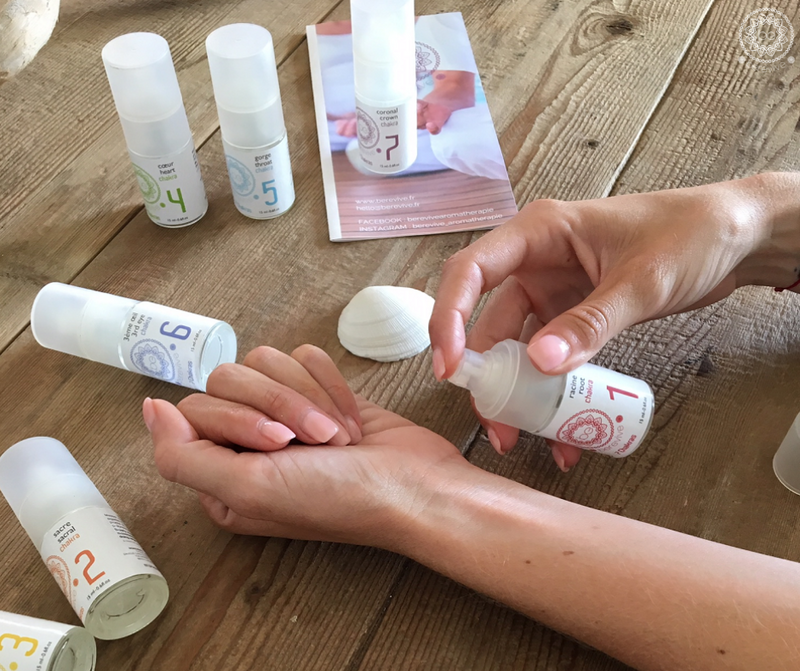
In modern practice, one can combine the recitation of a mantra with conscious breathing and the application of Berevive chakra oil to the corresponding area.
Thus, the vibration of sound, the olfactory frequency and touch unite to create a complete, sensory, energetic and emotional harmonization.
# The role of breath and consciousness in energy circulation
In the tantric and yogic tradition, breath (prāṇa) is the vital force that animates the body and connects the visible and invisible worlds.
The chakras are the energy nodes where this breath concentrates and transforms.
When prāṇa flows freely, the chakras rotate harmoniously; when it is blocked, emotions stagnate and vitality decreases.
The practice of prāṇāyāma (breath control) aims to purify the energy channels (nāḍī) and open the central passage, the sushumnā nāḍī , so that energy rises freely from the coccyx to the top of the skull.
Conscious breathing is like circulating light .
This is why, in each Berevive ritual, the application of a chakra oil is ideally accompanied by slow and conscious breathing , which guides the intention through the subtle body.
Breath thus becomes a vehicle: it carries the fragrance, the consciousness and the vibration to the center that one wishes to harmonize.
# Modern Conscious Practice: From Color to Vibration
Today, it is no longer a question of opposing or choosing between the old and the modern, but of reconciling the two .
Colour helps us to visualize; sound and breath bring us back to vibration.
This is where the contemporary path to energetic awakening lies: moving from simple symbolism to lived experience .
A conscious modern practice can be structured as follows:
- Choose a chakra to balance according to your feelings (fatigue, emotion, blockage).
- Visualize the associated color to guide consciousness.
- Breathe slowly , while placing your hand on the corresponding area.
- Apply Berevive chakra oil , feel the massage, feel its texture, its fragrance, its immediate effect.
- Repeat the bīja mantra in a low voice or internally, allowing the vibration to spread.
In a few minutes, the mind calms, the body recenters, and energy flows again.
This return to vibration, breath, and sensory experience is at the heart of the Berevive approach:
reconciling the science of breath, the wisdom of mantras, and the olfactory and vibratory power of plants.
It is no longer an abstract ritual, but a moment of profound union with oneself.
An inner journey where each chakra becomes a living, fragrant, vibrant space, an open door to balance and presence.
Rebalance your chakras with Berevive energy oils
# The alchemy between aromatherapy, energy work and Ayurveda
At Berevive, chakra re-harmonization is not a theory: it is a living experience of body and soul .
Each oil has been conceived as a vibrational frequency , a synergy of virgin oils and essential oils selected to act on the sensory, energetic and emotional levels.
Aromatherapy works here as a subtle medicine : aromatic molecules resonate with the nervous system, glands and the vibrational field of the body.
Ayurveda, for its part, guides the choice of plants according to the chakra and the elements (earth, water, fire, air, ether) and the doshas (Vata, Pitta, Kapha) , in order to restore overall balance.
Finally, the energetic dimension, at the heart of the Berevive philosophy, transforms each application into a conscious ritual .
Gesture, breath, texture, fragrance and intention merge to awaken a harmonious inner flow.
It is the meeting of care and the sacred : an alchemy between earth and light.
# The 7 Berevive Chakra Oils: A Sensory and Vibrational Approach
Each Berevive chakra oil has been designed as a unique energetic signature , combining the power of plants with the frequency of each subtle center.
They act through the senses: smell, touch, breathing and presence.
-
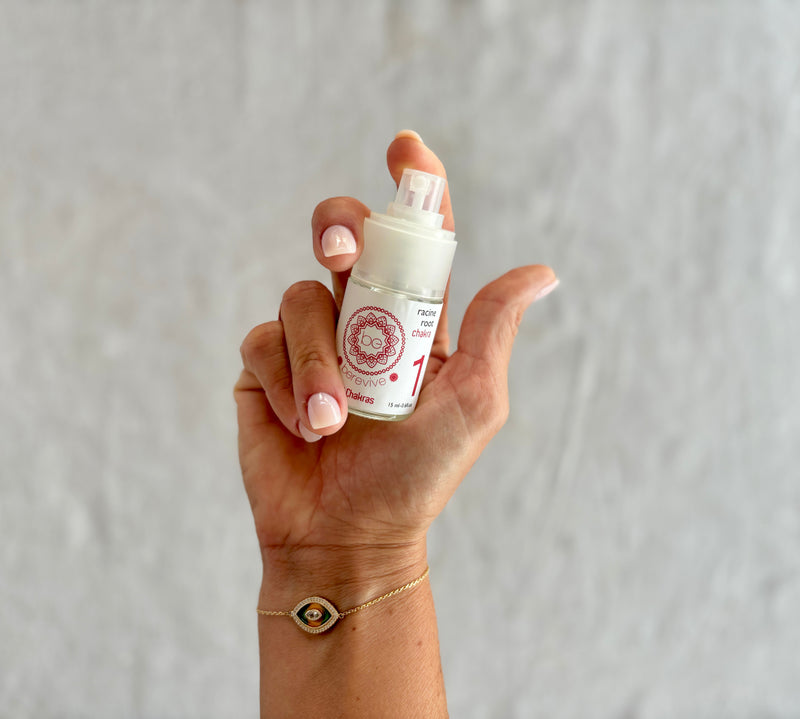
🔴 Root Chakra Oil – Stability & Grounding
A warm and woody synergy that connects to the Earth, strengthens inner security and restores vital energy.

-
🟠 Sacral Chakra Oil – Creativity & Pleasure
Soft and sensual notes that awaken the fluidity, joy and spontaneity of inner movement.

-
🟡 Solar Plexus Chakra Oil – Confidence & Radiance
A sunny and spicy accord that activates personal power, clarity, and self-affirmation.

-
💚 Heart Chakra Oil – Love & Compassion
A tender and floral fragrance that opens up to gentleness, heals emotional wounds and restores the flow of giving and receiving.

-
🔵 Throat Chakra Oil – Expression & Truth
A fresh and airy scent to free speech, clarify thoughts and rediscover authenticity.

-
🟣 Third Eye Chakra Oil – Intuition & Inner Vision
A profound and slightly mystical composition to awaken subtle perception, inner listening, and mental clarity.

-
⚪ Crown Chakra Oil – Connection & Awareness
A luminous and meditative essence that connects to the spiritual dimension and promotes inner peace.

These seven creations form a complete path of harmonization : from body to consciousness, from matter to light.
Their regular use creates a natural resonance between the physical, emotional, and spiritual planes, just like an inner rainbow realigning itself .
# How to choose your oil according to your energy center to rebalance
Listen to your body above all: it knows what it needs and tells you through the symptoms you feel.
Here are some guidelines to help you make your intuitive choice:
|
Current feeling or need |
Chakra involved |
Recommended oil |
|
Fatigue, insecurity, dispersion |
Root |
Root Chakra Grounding Oil |
|
Emotional blocks, lack of creativity |
Sacred |
Sacral Chakra Oil Fluidity |
|
Stress, loss of confidence, overwork |
Solar plexus |
Chakra Plexus Oil Radiation |
|
Heartbreak, sadness, loneliness |
Heart |
Compassion Heart Chakra Oil |
|
Difficulty expressing oneself or listening |
Throat |
Throat Chakra Oil Expression |
|
Lack of clarity, intuition, or vision |
Forehead |
Chakra Forehead Oil Intuition |
|
Need for spiritual alignment or inner peace |
Coronal |
Crown Chakra Oil for Awareness |
# Recommended Berevive Ritual:
Apply a few drops to the chakra area
Breathe in the fragrance deeply, then consciously recite the corresponding bīja mantra .
Feel it.
Vibration, breath, and scent come together to recreate the original energy flow.
At Berevive, each bottle is more than a treatment: it is an invitation to alignment .
A bridge between aromatherapy and spirituality, between the gesture of the body and the breath of the soul.
Because true balance is not something you think about: it is something you live, breathe, and feel.
In conclusion, what if chakras were much more than just colors?
The chakras are not simply colored discs aligned along a meditative silhouette.
They are living fields of consciousness , spaces of inner experience where matter and light meet.
The rainbow we know today is not a betrayal of the ancient teachings; it is a modern translation of their eternal message:
Life is a vibration, and every human being is a wave of light in motion.
We are nothing but energy.
Yes, the colours were codified recently.
But behind these hues, the original wisdom remains intact : that of breath, sound, feeling, and presence.
The modern model, when practiced consciously, then becomes an initiatory gateway, a means of entering into the frequency of oneself.
The chakras do not need to be believed.
They demand to be felt .
Because the truth of the energetic body is not a concept, it is an experience, that of an alignment where everything flows freely: breath, light, heart, consciousness.
So, if colours can help us on this path, all the better!
Don't believe, experience, feel...
This is the very concept of the sacral chakra: to test, to have one's own experience, and then to imprint it as such at the level of one's solar plexus chakra; ego and personal power. So:
Close your eyes.
Breathe.
Let the scent, color, and sound blend together in your interior space.
This is where it all begins: in the vibrant silence of the present moment.
Discover Berevive chakra oils and awaken the original vibration within you.
Each bottle is a gateway to balance: a sensory, energetic and sacred ritual.
From the earth to the summit, from the roots to the crown, let the energy flow again throughout your entire being.
Explore the Berevive Chakra Oil Collection
FAQ – The true colors of the chakras
🔹 Are the colors of the chakras really recent?
Yes. The “rainbow” color code dates back to the late 1970s, popularized by Christopher Hills.
Ancient texts describe lotuses, sounds, and elements, but no fixed palette.
🔹 Is it still possible to meditate with colors?
Absolutely. Colors affect emotional and energetic perception.
They are modern vibrational tools , perfectly compatible with energy practice.
🔹 How can you tell if a chakra is blocked?
Certain signs may be cause for concern: fatigue, repetitive emotions, localized physical tension, loss of vitality.
Observation, conscious breathing, and energy healing (such as Berevive chakra oils) help to restore natural circulation.
🔹 What is the best way to use Berevive chakra oil?
Apply a few drops to the corresponding area, breathe deeply and pronounce the associated bīja mantra .
This ritual unites perfume, breath and consciousness, a method of complete sensory and energetic harmonization.
Olive
Founder of berevive.